

This Is Personal
Embroidery for forever, featuring the founders of Eva Joan

I can map the biggest moments of my life by the monograms my grandmother gave me to commemorate them. Like crushes and haircuts, my initials, my name in a laser-stitched serif are omnipresent and monumental. Each like a vivid sense memory tied to exactly that birthday or graduation. I know I turned seven because I have the “Kate” L.L. Bean tote to prove it — one with purple checkered handles and just enough room for the little pajamas I'd bring to my first sleepover. I know I got into college because I still use the personalized Dopp kit in my school’s colors. I know I moved to the city because Nonna got me custom towels to hang in my new Manhattan bathroom.
Little hints of my contemporary personality exist in every font choice, every color, every configuration of the letters. My first name in dark blue, first and last in pink, sometimes my initials but much less in the last decade, ever since they took on a new meaning (they’re “KMS” which is: unfortunate.) Every towel and tote is some level of stained and patinated, but they’re all eternal to me.
The monogram is an artform. My grandmother is its Michelangelo. The L.L. Bean personalization tool is her chisel, and each initialed bag she ever gave me was another David. But in the past four years, the personalized tote has undergone a renaissance. We, the generation slouching towards adulthood, took the chisels into our own hands. We looked at the ten characters L.L. Bean allotted us with the eyes of the modern age, manipulating them to ends neither Nonna nor Michelangelo could have fathomed. We’d use this blank space to express ourselves much more literally, with things we found witty, dog whistles and inside jokes. Rebecca’s tote would no longer say “Rebecca,” Jenny’s not “JENNY.” They would now say things like “emotional baggage.” “nepo baby.” “WTF.”
At the center of this shift is the Instagram account that made it viral, @ironicboatandtote, founded and run by Gracie Weiner. I’m on there, with beloved “dad” bag my friend Eliza got me for my 25th birthday. (I’m “dad” to my friends because I offer to carry the heaviest things and because I can burp on command.) The account reached a mass audience in 2022, with a following of 60.8K today. Gracie was featured in Vogue and The New York Times and Harper’s Bazaar and even released her own collaborative collection with L.L. Bean — a line of robes and tote bags, ironically pre-embroidered. Boat and Tote sales hit a ten-year high.
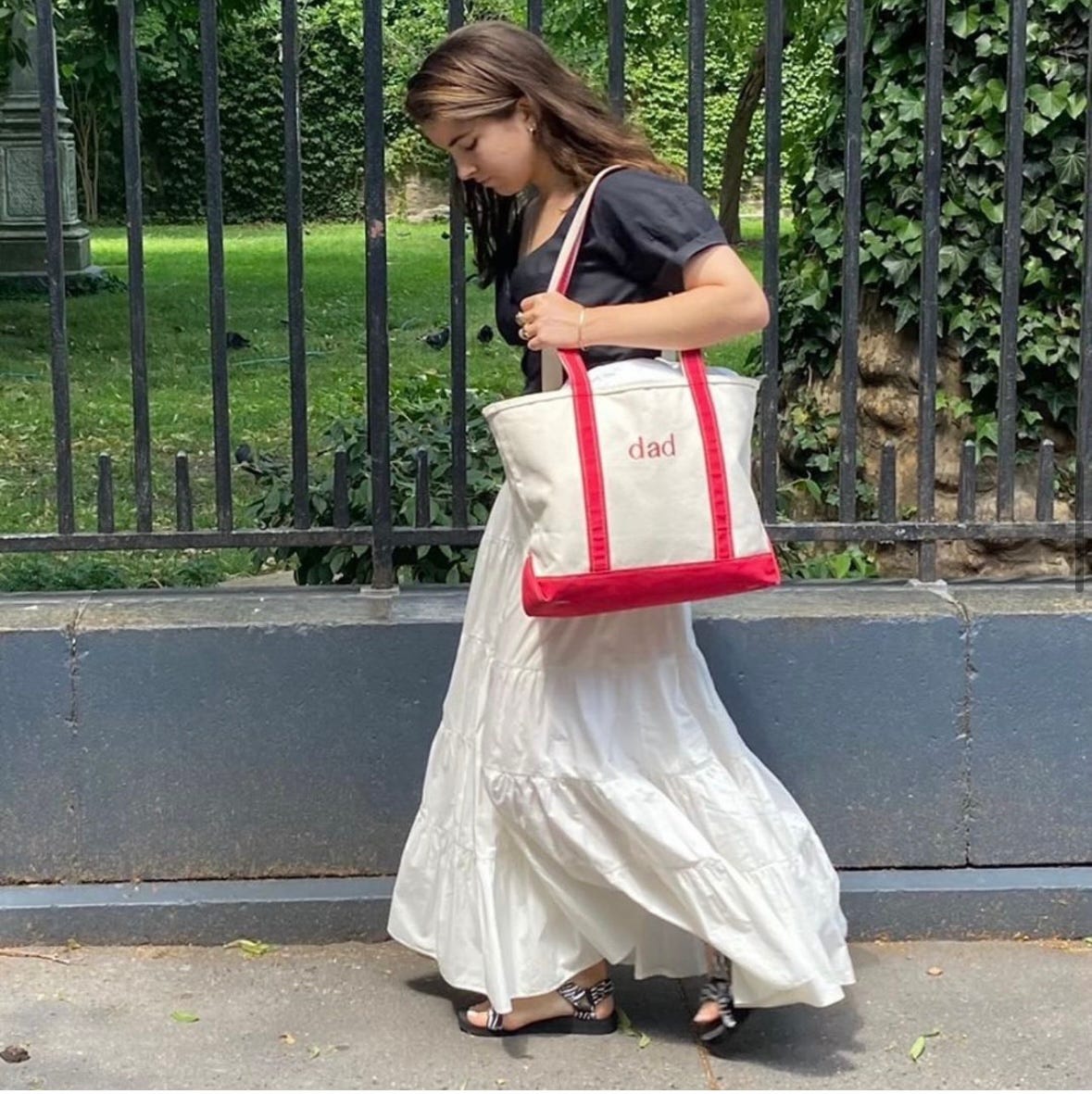
That spike was evident on every commute, every errand run and rapid tap through my Instagram stories. There’d never been so many tote bags, and each one was steeped in that eponymous irony. “GUCCI” and “unhinged” and “mayonnaise.” Soon, for the Boat and Tote’s ubiquity, personalization became almost a common good. Brands and PR companies caught on, and not a weekend goes by without access to embroidery, free with purchase.
Right alongside “what would my Real Housewives tagline be,” “what should I embroider on my hypothetical Boat and Tote” became a near constant thought exercise for me, my brain pinballing between niche cultural references and bad puns. I wanted to be prepared when the producers called and when it was my turn at the chain-stitch machine, respectively. But there’s been a shift. And the feeling that I get each time I approach the needle has grown increasingly complicated. Instinctively I run through all the ways I could try to be funny, or what could make a good Instagram or what would make someone say “haha, nice one” on the subway, And then I opt finally for “Kate.”
The motivations behind this decision are two-pronged. Prong One is “get over yourself.” Trying constantly, desperately to signal that I’m funny is my most exhausting habit. My most destructive intrusive thought, worse than “drop the baby.” I want to put my ego aside and quash the compulsion to make the tote bag yet another vehicle for whatever wit I think I have. Prong Two: I’ve waited in line, I’m paying, unless the PR budget is. I want this to be permanent. I don’t want to tattoo my new tote with something I’ll regret. Chain-stitching can last forever, if I choose something lasting, and I’ll always be “Kate.”
I’ve noticed, on the same commutes and errand runs and dinners out once littered with little quips, other people are choosing their version of “Kate,” too. More and more, the monograms I see are simple and earnest. Just names and initials, like my grandma intended, and ironic Boat and Totes seem to have receded from the zeitgeist. My friend Isabel took a needle to her own just last month, unstitching the word “Imprudent” (which she chose because it’s Jane Austen’s favorite and she loves Jane Austen), leaving just the floating “I.” Now for Isabel.
I don’t intend to declare the death of the ironic Boat and Tote, or to cast aspersions on anyone’s chosen slogans. What I’m addressing in myself, though, in the rationalization of every chain-stitch, is the intention behind it. The cotton canvas was once canvas anew, stretched to express my personality or quirks or sense of humor. Something I could post on Instagram. even tagging Gracie’s account to be featured there, too. But things done for the benefit of Instagram are not often lasting. The “PSYCHO” bag stays in the closet. I bring my “Kate” bag to the park.
The novelty has worn off, embroidery is everywhere. And in that, a responsibility to harness its potential. Something beyond canvas bags, bought new, and made disposable by phrases we often outgrow, and instead for the opposite — the chance to make the things we carry and wear eternal. For help in articulating that potential, I visited Bjorn and Emma. They’re the founders of Eva Joan, a one-of-a-kind repair shop in the West Village, born from their mission for conscious consumption, education, and making and mending clothes to last forever. In their eyes, the ubiquity of personalization could be wielded in service of exactly their founding ethos.
“It used to be niche, and it’s not anymore.” Emma said. “For us, that’s exciting.” They don’t care at all about the content of what their clients choose to have embroidered, so long as it’s carefully considered. What matters to them is the commitment that hand-stitched embroidery connotes: “It means that something that you would have disregarded is more considered or more valuable. That’s extremely positive. Even if it’s a trend, currently, it’s still very exciting to us. If you put your initials on a sweater, you’ll keep the sweater.”
It’s exactly the transformation I felt when I brought my prized ‘50s baseball jersey to Eva Joan. It was riddled with ancient sweat stains and slightly worse for wear, but once they’d chain-stitched “Kate” across the back shoulders, it didn’t matter. The sweat stains are mine now. I’ll have it always.
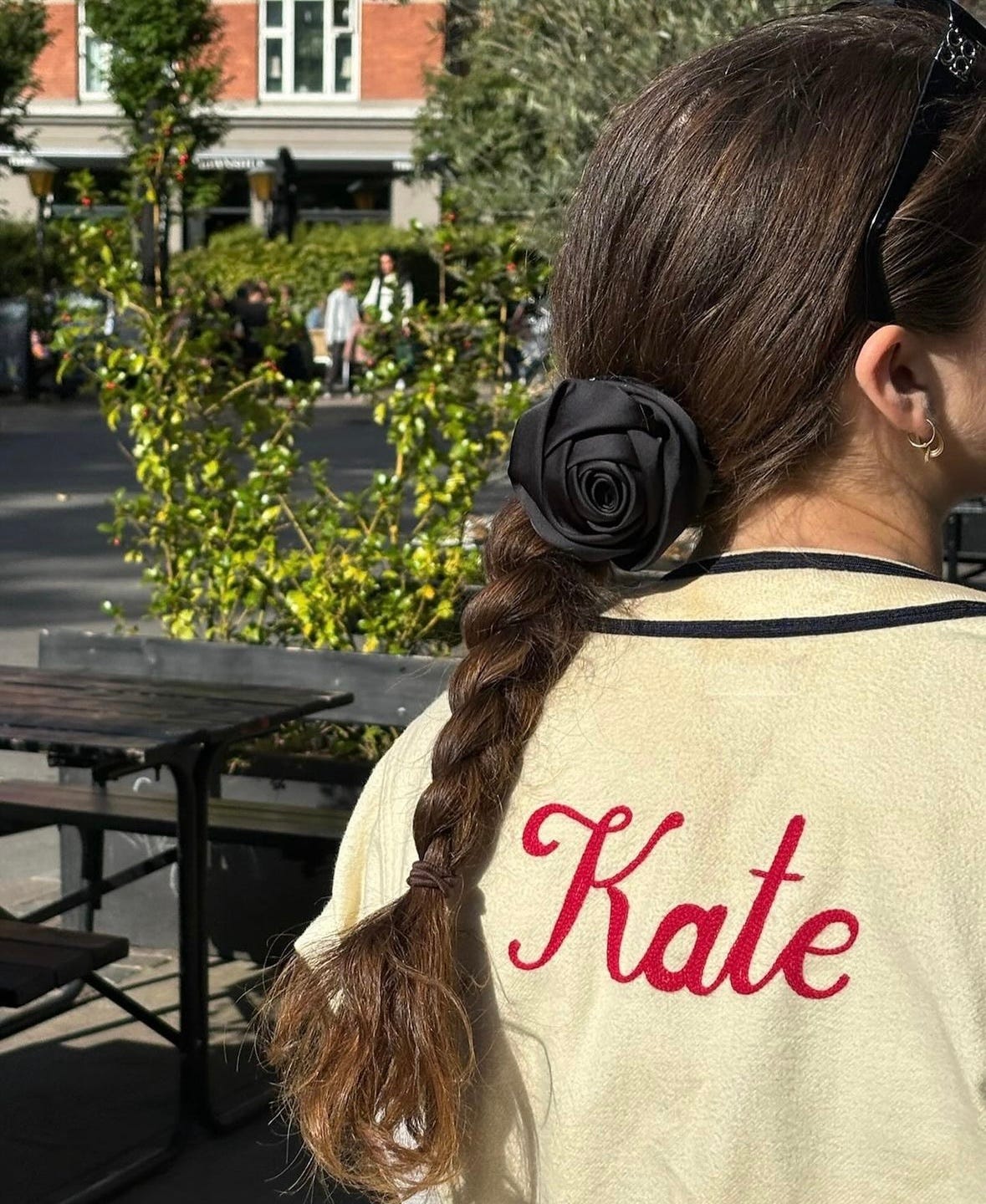
“We’re always trying to rejog that notion in people’s heads,” Emma insisted. “If you spend money on something, you get invested in it. It’s the value in the fact that you’ll keep it forever. I think if you put your name on something, you’re probably ten times less likely to throw it away, or donate it, or whatever, because it’s yours. You’ve committed.”
Everything about Eva Joan is anti-trend. Bjorn and Emma cringed when I said the word, especially when applied to personal embroidery — something that has the capacity to lift an item of clothing from the trend cycle completely, especially in their hands. What they identified in the shifts they’d seen in their own clients is beyond trend. It’s evolution.
“We see, especially with customers, three years in, the differences between their entry-level project and their current projects,” Bjorn explained. They’ll start with their initials, or symbols that remind them of home, marking the outside of their garments. But with time, clients begin bringing in suits and sweaters to be embroidered internally — on linings and pockets and lapels. “When it’s dainty, and secret, and concealed, there’s something really really nice about that.” Emma calls it “a graduation.” Those are her favorite projects. “The ones where people leave secret messages for themselves. ‘This is for no one, it’s just for me.’” She herself embroiders her initials and the date on every pair of pajamas she owns.
I think this is the same timeline I feel that I’m on, and that Isabel’s on and that every stranger I see toting something personal and tacitly un-ironic is on, too. I’ve done it for Instagram, I do it now so I’ll have it forever. A sartorial scrapbook of my whole life, named and dated. They’re my favorite things to find vintage, too. Even if I have no idea who “Rick” is, wearing his bowling shirt makes me feel immediately tied to his history. Clothes with names have spirit stitched in.
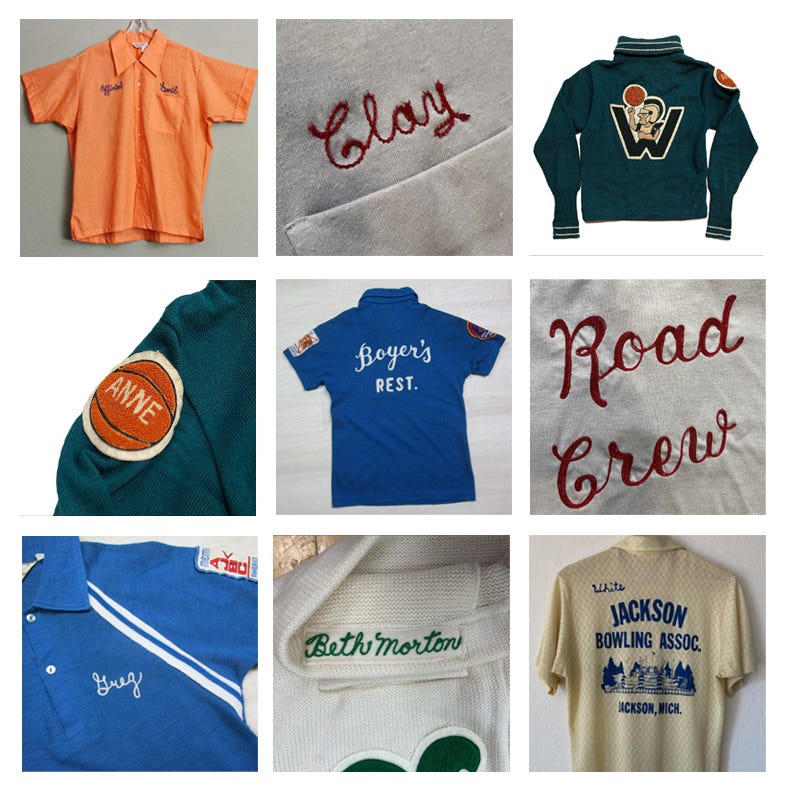
If the Boat and Tote at its worst is a billboard for witticisms, oriented for grid posts, this is its counter. Embroidery intended only for the wearer, stripped of external projection. A commitment to keeping that piece all your life, mending it when it rips, and finally passing it down. Instant heirlooms.
Currently eyeing the ‘pond scum’ boat & tote scowling at me from under my bed, little used and oft forgot
Spirit stitched in!!! I love that sm